Planned expedition · December 2027

Antarctica

From the North Pole to the far south. Our next planned journey brings together scuba diving, science and learning in the field.

The next expedition

Science above and below the surface

In December 2027, our family plans to travel aboard M/V Hondius to the Antarctic Peninsula and South Shetland Islands, combining scientific fieldwork, scuba diving and learning alongside researchers.

After the North Pole, Kilimanjaro, Mount Fuji and our diving journeys, Antarctica offers a chance to connect those experiences. For Maika and Olivier, the aim is to arrive with their own research questions, contribute to the work and bring what they learn back to other young people.

Expedition dates19–29 December 2027
ShipM/V Hondius
Departure & returnUshuaia, Argentina
Our statusIn planning
The scientific programme

Working alongside researchers

The planned research asks what lives beneath Antarctic waters, how we can document it, and what traces of human activity reach this remote environment.

Marine biodiversity

Divers will photograph and, where authorised, collect seabed organisms for the Natural History Museum of Los Angeles County. Young explorers will help sort, label and document specimens under scientific supervision, contributing to collections available for future research.

Microplastics & microfibres

Researchers plan to examine organisms, seawater and sediments for tiny plastic particles and fibres. One proposed study will compare visitor landing areas with nearby less-disturbed sites to investigate the possible contribution of clothing fibres.

DNA & underwater cameras

Planned eDNA sampling will look for traces of marine life in seawater. A proposed baited underwater camera study could record fish and other animals beyond scuba depth, complementing what divers see. Laboratory arrangements and camera deployments are still being developed.

Life in the sediments

Seabed samples will be examined for tiny organisms, including foraminifera. For the young explorers, this offers a chance to practise microscopy and discover a part of Antarctic life that is easily overlooked.

Two seasons, connected by science

A reconnaissance voyage in December 2026–January 2027 is planned to collect initial samples and document research locations. During 2027, the young explorers will work with scientists on those samples and observations before heading south themselves. Our December 2027 voyage will aim to revisit accessible sites, providing an initial comparison roughly a year apart.

Research activities depend on permits, final scientific arrangements, weather and sea ice. Repeat visits to individual sites cannot be guaranteed.

Preparing to dive in Antarctica

Cold-water and drysuit training will run alongside the science preparation. Divers must meet the expedition’s certification and experience requirements, including at least 30 drysuit dives. Young explorers will also have research roles aboard ship, from specimen documentation to working with samples and observations.

The expedition team

Experience shared across generations

The programme brings together scientists, experienced divers, families and a planned group of up to 32 Young Explorers and Scouts.

The October 2026 team list names 14 Explorers Club members, including one whose participation is still pending. Their experience spans polar fieldwork, marine research and earlier Young Explorers expeditions. Final participation is still being confirmed.

For our family, the connection with the 2018 North Pole expedition is especially meaningful: another opportunity for young people to work alongside experienced explorers and take an active part in research.

Where we plan to explore

The Antarctic Peninsula & South Shetlands

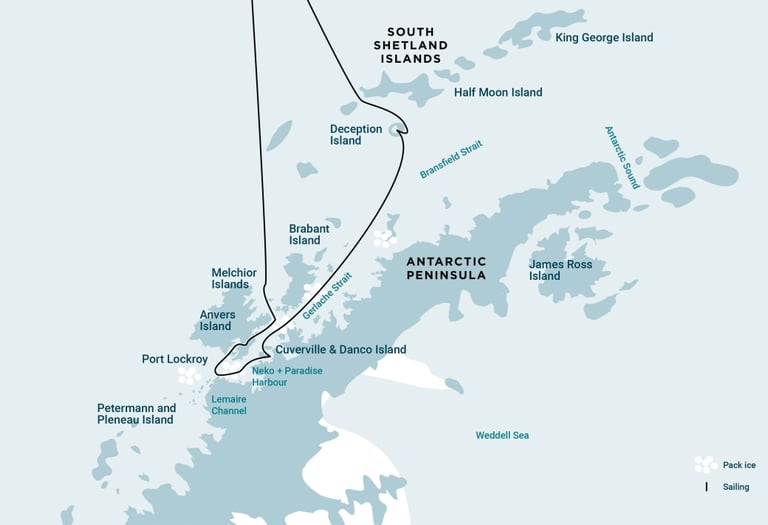
Our voyage begins in Ushuaia, at the southern tip of Argentina, and crosses the Drake Passage to the South Shetland Islands and Antarctic Peninsula before returning north.

Antarctic expedition route map from Jeff Bozanic’s Antarctica 2027 page
Planned expedition route; exact landings depend on ice, weather and conditions. Map from Jeff Bozanic’s Antarctica 2027 expedition page, where you can find further expedition details.

Ushuaia

Our departure and return port on Tierra del Fuego.

South Shetland Islands

The island group north of the peninsula, with Deception Island a possible stop.

Antarctic Peninsula

The main area for exploring Antarctica’s coastline, wildlife and marine environment.

See the expedition programme for current arrangements.

Our base at sea

Aboard M/V Hondius

Operated by Oceanwide Expeditions, Hondius is an ice-strengthened Polar Class 6 expedition vessel with room for 170 passengers in 80 cabins.

At 107.6 metres long, the ship combines accommodation with spaces for observing and learning. A large observation lounge and separate lecture room support talks, workshops and time together between excursions.

Zodiacs take passengers from ship to shore. Two gangways and a sheltered boarding area support these operations. Cabins range from shared porthole accommodation to suites, including options with balconies.

Life aboard is informal. Outdoor decks provide views of the surrounding landscape, while the lounge offers a warm place to gather during the crossings.

Explore Hondius, cabin options and deck plans

Ship information: Oceanwide Expeditions.
Education & outreach

Bringing Antarctica into the classroom

We are planning to work with educational institutions and NGOs to share the expedition with young people, both live from Antarctica and after we return.

This builds on our North Pole experience, when the children brought their journey into schools through presentations, films and conversations with other pupils.

Preparation will begin well before departure. The planned youth programme pairs participants with scientific mentors to develop questions, practise sampling and microscopy, and learn how to record results. We want Maika and Olivier to follow that process from their first questions through to fieldwork and sharing what they find.

Live from Antarctica

We plan to connect with schools and partner organisations during the expedition, sharing observations, conversations and updates from the field. Live sessions will depend on connectivity and the expedition schedule.

After we return

School visits and presentations will give us time to share photographs, discuss what we learned and answer questions. We want to help students connect polar science, the ocean and conservation with their own lives.

Partnerships and activities are being developed as part of our preparation.

Explore our education work · Read about our earlier diving journeys

Follow the plans

The next chapter is taking shape.

Full expedition details